
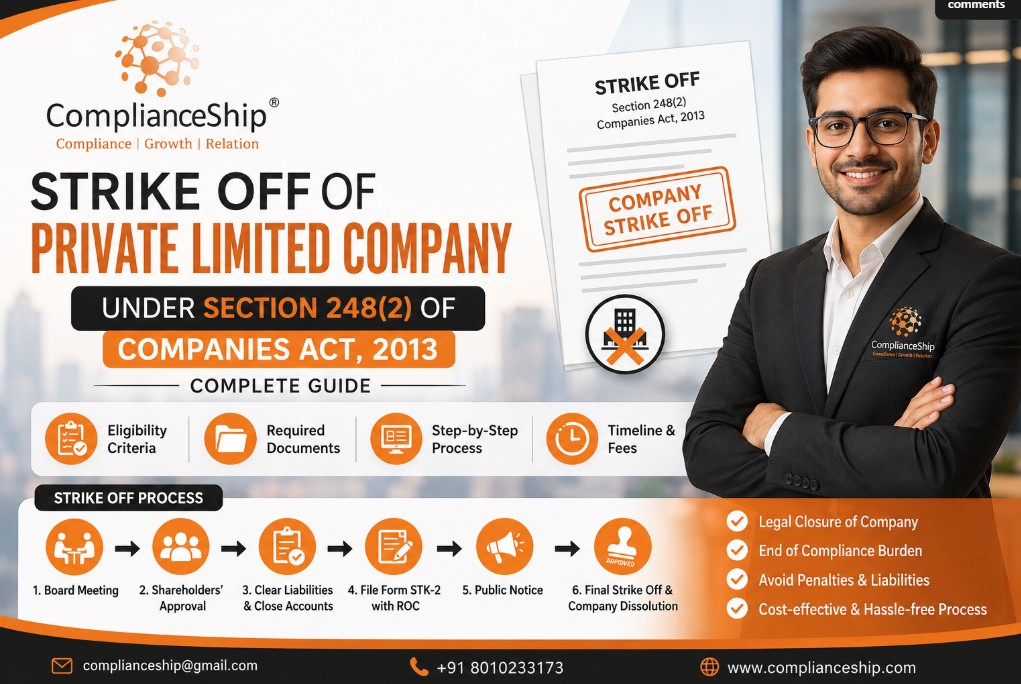
Closing a business is just as important as starting one. Many business owners assume that if they stop operations, their company automatically ceases to exist. However, under the Companies Act, 2013, a Private Limited Company continues to remain legally active until its name is officially removed from the Register of Companies (ROC).
An inactive company is still required to comply with annual filing requirements, maintain statutory records, and fulfill various legal obligations. Failure to do so can lead to penalties and unnecessary compliance costs.
To provide a legal and hassle-free exit, the Companies Act, 2013 allows eligible companies to voluntarily close their business through the Strike Off process under Section 248(2).
In this comprehensive guide, you’ll learn everything about the Strike Off of a Private Limited Company, including eligibility criteria, required documents, the complete filing process, timelines, important compliance requirements, and frequently asked questions.
What is Strike Off Under Section 248(2)?
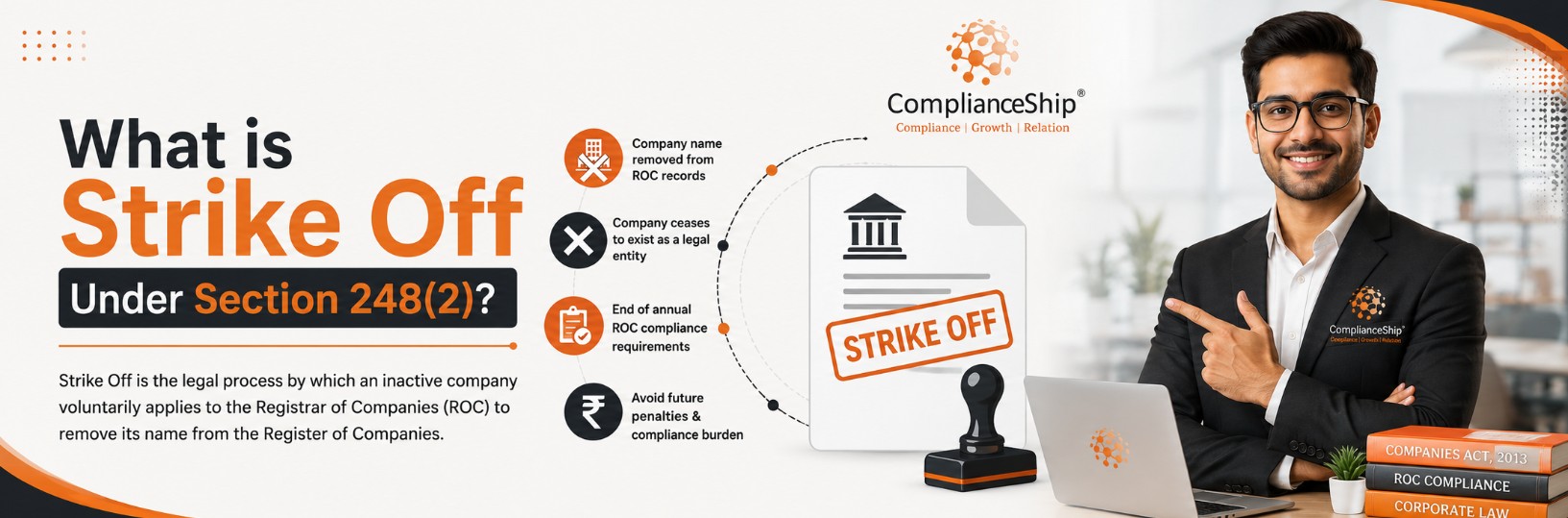
Strike Off is a legal procedure through which an inactive company voluntarily applies to the Registrar of Companies (ROC) to remove its name from the Register of Companies.
Once the application is approved:
- The company’s name is removed from the MCA records.
- The company is dissolved as a legal entity.
- Annual ROC compliance requirements come to an end.
- The business is legally closed.
The strike-off process is governed by Section 248(2) of the Companies Act, 2013 and the applicable Companies (Removal of Names of Companies from the Register of Companies) Rules.
It is considered one of the simplest and most cost-effective ways to close an inactive Private Limited Company.
Who Can Apply for Strike Off?
A Private Limited Company can apply for voluntary strike off if it fulfills the following conditions:
- The company has ceased business operations.
- It has remained inactive for at least two consecutive financial years or since incorporation.
- The company has no outstanding liabilities.
- All creditors have been paid.
- There are no pending secured or unsecured loans.
- All bank accounts have been closed.
- GST registration has been surrendered or cancelled, wherever applicable.
- Income Tax and ROC compliances have been completed up to the year in which business operations stopped.
- No legal proceedings or regulatory actions are pending against the company.
Meeting these conditions is essential before filing the strike-off application.
Benefits of Striking Off an Inactive Company
Voluntarily striking off an inactive company offers several advantages, including:
- Eliminates future ROC filing obligations.
- Prevents penalties due to non-compliance.
- Reduces recurring compliance costs.
- Provides a legal and clean exit from business.
- Removes the burden of maintaining statutory records.
- Avoids unnecessary annual audit and filing expenses for inactive entities.
For companies that no longer intend to operate, strike off is often the most practical closure option.
Documents Required for Company Strike Off
Before filing Form STK-2, the following documents are generally required:
- Board Resolution approving the strike-off proposal.
- Special Resolution passed by shareholders or consent from at least 75% of members.
- Form STK-3 (Indemnity Bond) signed by every director.
- Form STK-4 (Affidavit) signed by every director.
- Statement of Accounts certified by a Chartered Accountant (not older than 30 days from the filing date).
- PAN Card of the Company.
- Authority Letter or Power of Attorney, if the application is filed through a practicing professional.
- Copy of Board Meeting Minutes.
- Any additional documents required by the ROC, if applicable.
Preparing complete and accurate documentation helps avoid unnecessary delays during the approval process.
Step-by-Step Process to Strike Off a Private Limited Company
Step 1: Hold a Board Meeting
The Board of Directors convenes a meeting to approve the proposal for striking off the company and authorizes a director to complete the filing formalities.
Step 2: Obtain Shareholders’ Approval
The company must obtain approval through:
- A Special Resolution passed by shareholders, or
- Written consent from members holding at least 75% of the paid-up share capital.
Step 3: Settle All Outstanding Liabilities
Before filing the application, ensure that:
- All creditors have been paid.
- Income Tax liabilities are cleared.
- GST dues are settled.
- Employee dues are paid.
- Vendor payments are completed.
- All loans have been repaid.
The company should have Nil Liabilities at the time of filing.
Step 4: Close Company Bank Accounts
Every bank account in the company’s name should be closed before filing Form STK-2.
Step 5: Prepare Required Documents
Prepare all mandatory documents, including:
- Form STK-3
- Form STK-4
- Chartered Accountant-certified Statement of Accounts
- Board Resolution
- Shareholders’ Resolution
Step 6: File Form STK-2
The authorized director files Form STK-2 on the MCA portal along with:
- Supporting documents
- Digital Signature Certificate (DSC)
- Prescribed government filing fee
Step 7: ROC Examination
The Registrar of Companies verifies:
- Company records
- Pending compliances
- Financial status
- Attached documents
- Legal proceedings, if any
If the application is found satisfactory, the ROC proceeds to the next stage.
Step 8: Publication of Public Notice
The ROC issues a public notice inviting objections from stakeholders within the prescribed period.
Step 9: Final Strike Off Order
If no valid objections are received and all legal requirements are satisfied, the ROC publishes the final notice in the Official Gazette and removes the company’s name from the Register of Companies.
From this date, the company is considered legally dissolved.
Timeline for Company Strike Off
The approximate timeline is as follows:
| Activity | Estimated Time |
|---|---|
| Document Preparation | 1–2 Weeks |
| Filing Form STK-2 | 1 Day |
| ROC Scrutiny | 1–2 Months |
| Public Notice Period | 1–2 Months |
| Final Strike Off Order | Total 3–6 Months |
The timeline may vary depending on the ROC office and the completeness of the documents submitted.
Government Fees for Company Strike Off
The Ministry of Corporate Affairs prescribes a government filing fee for Form STK-2.
In addition to the government fee, professional charges may vary depending on:
- Pending ROC filings
- GST cancellation
- Income Tax compliance
- Number of financial years requiring updates
- Complexity of documentation
Obtaining professional assistance can help ensure accurate filing and reduce the chances of rejection.
Important Compliance Checklist Before Filing Form STK-2
Before submitting the application, ensure the following:
- All ROC annual filings are completed.
- Income Tax returns have been filed.
- GST registration has been surrendered or cancelled (where applicable).
- Company bank accounts are closed.
- No outstanding loans exist.
- All creditors have been paid.
- No legal proceedings are pending.
- Directors’ DINs are active.
- The Statement of Accounts is certified by a Chartered Accountant.
Completing this checklist can significantly improve the chances of a smooth approval.
Common Reasons Why the ROC Rejects a Strike Off Application
The Registrar of Companies may reject a strike-off application if:
- Annual ROC filings are pending.
- The company has unpaid liabilities.
- Incorrect or incomplete documents are submitted.
- The Statement of Accounts is outdated.
- Legal or regulatory proceedings are pending.
- Active business transactions are detected.
- Tax dues remain unpaid.
Ensuring compliance before filing helps avoid delays and rejections.
Frequently Asked Questions (FAQs)
Is ROC annual filing mandatory before applying for strike off?
Yes. Companies should complete all pending ROC filings up to the financial year in which business operations ceased.
Can a company with GST registration apply for strike off?
Yes. However, the GST registration should generally be surrendered or cancelled before filing Form STK-2.
Can a company having outstanding loans apply for strike off?
No. All secured and unsecured loans must be repaid before applying for strike off.
Which form is used for company strike off?
The application is filed using Form STK-2.
How long does the strike-off process take?
The process generally takes 3 to 6 months, depending on the ROC office and the completeness of the documentation.
Can ROC reject the strike-off application?
Yes. Applications may be rejected if there are pending compliances, liabilities, incorrect documents, or ongoing legal proceedings.
Is professional assistance recommended?
Yes. Professional assistance helps ensure proper documentation, timely filing, compliance verification, and a smoother approval process.
Conclusion
The Strike Off of a Private Limited Company under Section 248(2) of the Companies Act, 2013 provides a simple, legal, and cost-effective way to close an inactive business.
Instead of allowing an inactive company to accumulate penalties and ongoing compliance obligations, eligible companies can voluntarily apply for strike off through the Registrar of Companies. By ensuring that all liabilities are cleared, statutory filings are completed, and the required documents are correctly prepared, businesses can achieve a hassle-free closure.
If your company has stopped operations and meets the eligibility criteria, initiating the strike-off process at the right time can help you avoid future compliance burdens and legal complications.
Need Assistance with Company Strike Off or ROC Compliance?
At Complianceship Venture Solution LLP, we provide end-to-end assistance for:
- Company Strike Off under Section 248(2)
- Form STK-2 Filing
- ROC Annual Compliance
- Annual Return Filing
- GST Registration Cancellation
- Director KYC Compliance
- Company Closure Documentation
- MCA Filing Support
Our experienced professionals ensure that your company closure process is completed accurately, legally, and with minimal delays.
Contact Us

Complianceship Venture Solution LLP
📧 Email: complianceship@gmail.com
📞 Phone: +91 8010233173
Get in touch with our experts today for reliable and hassle-free company strike-off services.


Leave a reply